

Previously, we explored the neuroscience behind boredom shopping. How your dopamine system is wired for seeking, not having. How apps exploit variable ratio reinforcement to keep you scrolling. How your brain adapts, always needing more to feel the same spark.
Understanding chemistry is essential, but knowing your vulnerabilities to it matters even more.
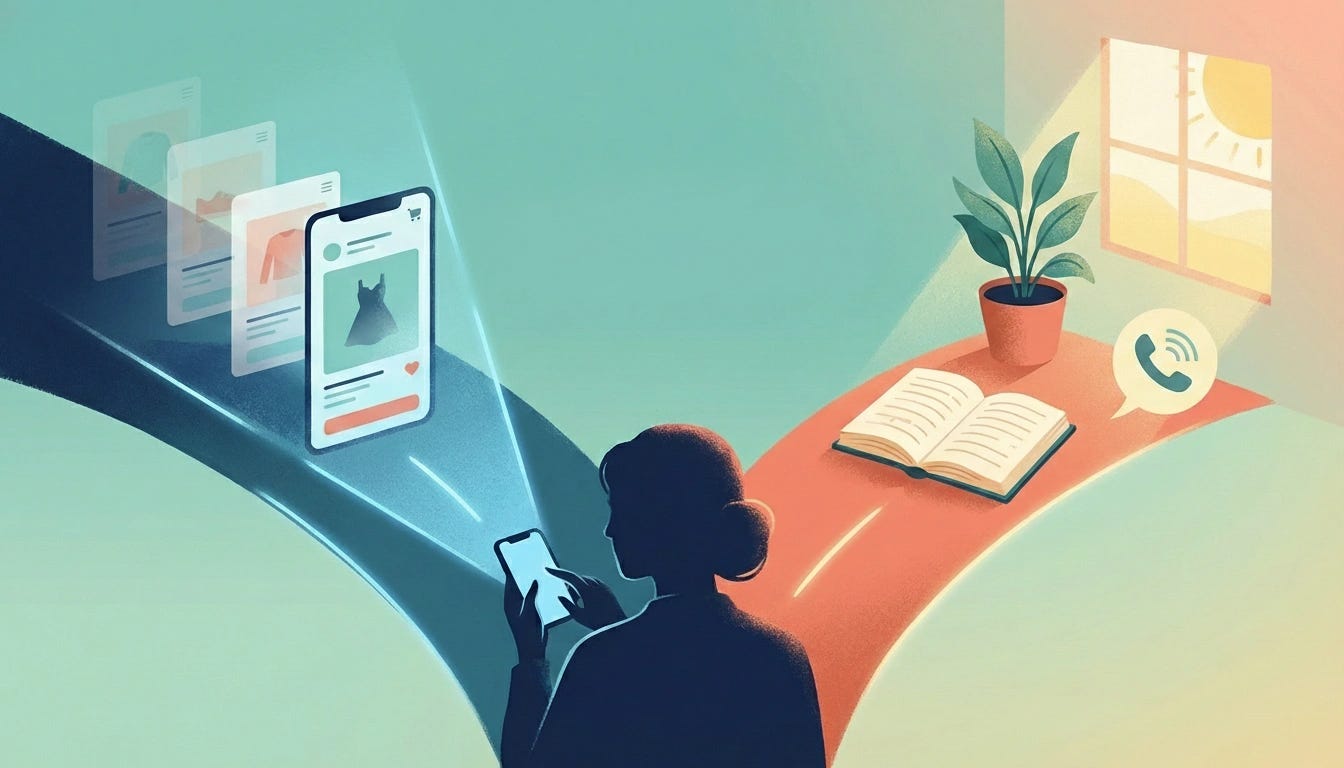
Tuesday, 8 PM. Sunday afternoon, 2 PM. Thursday, after that long work meeting. We all have our danger zones—specific moments when your thumb seems to find a shopping app on its own. When browsing “just to look” turns into a full cart.
The pattern feels random, but it’s not. And once you start noticing when and where you’re most vulnerable, you gain something powerful: the ability to prepare instead of react.
The Trigger Map
Remember from the last post: willpower alone won’t win this fight. You’re not battling a lack of discipline—you’re up against brain chemistry designed to seek novelty and apps engineered to exploit that wiring.
But here’s the good news. While you can’t control the dopamine cascade that starts the moment you open a shopping app, you can control whether you open the app in the first place. And that control starts with recognizing your patterns.
Most boredom spending follows predictable rhythms. Not the same patterns for everyone, but patterns nonetheless.
Research on impulse control shows that our willpower fluctuates throughout the day. A study from the Journal of Personality and Social Psychology found that self-control is weakest when we’re dealing with what they call “ego depletion”—basically, when our mental energy is already spent on other decisions.
That’s why the evening hours are prime time for emotional spending.
You’ve used up your decision-making energy at work, navigating traffic, and managing family dynamics. Your brain is tired. And when your brain is tired, that seeking system we talked about last week becomes louder. Shopping feels easy.
But time of day is just one piece. Location matters too. Environment matters. Your emotional state matters. Even who you’re with (or not with) can make you more vulnerable.
Common Trigger Scenarios
Let’s look at some patterns that show up repeatedly:
The Evening Scroll: You’re winding down from the day. Too tired to do something effortful, but not ready for sleep. Your phone is right there. Before you know it, you’re deep in product reviews for things you didn’t know existed thirty minutes ago.
According to consumer behavior research, 65% of online shopping happens between 8 PM and midnight. That’s not a coincidence. That’s tired brains seeking an easy dopamine hit. And remember—your brain gets that dopamine hit from browsing and anticipating, not from the actual purchase. The scroll itself is the reward.
The Sunday Afternoon Void: Weekend plans fell through, or you finished everything you meant to do. There’s unstructured time stretching ahead. You feel restless but don’t know what you want to do.
Studies on boredom proneness show that the gap between finishing planned activities and starting new ones is a time of peak vulnerability. Your brain registers the void and reaches for the fastest source of novelty.
The After-Stress Relief: You just finished something hard, a difficult conversation. A stressful deadline. Your nervous system is still activated, but the crisis is over.
Research on emotional regulation shows that we often seek reward after stress to signal “safety” to our bodies. Shopping provides that signal instantly.
The Social Media Spiral: You see someone’s haul video. A friend’s new outfit. An influencer’s “must-haves.” Suddenly, you’re comparing your closet to theirs and finding it lacking.
Comparative spending is real. Research from the Journal of Consumer Research found that exposure to others’ purchases increases our own buying behavior by 25-30%, even when we weren’t planning to shop.
The Waiting Game: Doctor’s office. DMV. Long commute. You’re stuck somewhere with nothing to do and no control over when you can leave.
These moments hit multiple triggers at once: boredom, a lack of control, and a sense of wasted time. Shopping provides all three remedies—stimulation, choice, and a sense of productivity.
What’s Your Pattern?
Take a few minutes with these questions. No judgment. Just curiosity.
Time-Based Triggers:
When during the day do you most often browse shopping apps or sites?
Which day of the week sees the most purchases?
Is there a specific season when you spend more emotionally?
Emotional State Triggers:
What feelings most often precede a shopping urge? (Bored, stressed, lonely, angry, celebrating, numb?)
Do you shop more when you’re tired or energized?
Does your spending change based on how your day went?
Environmental Triggers:
Where are you physically when the urge hits? (Home, work, in transit, specific stores?)
Are you alone or with people?
What were you doing right before you started browsing?
Social Triggers:
Does social media use increase your shopping urges?
Do you shop more after seeing friends, or do you feel more disconnected?
Are there specific people whose presence (or absence) affects your spending?
The patterns might surprise you once you write them down.
Building Your Defense Strategy
The last post ended with a critical question: What do you do in the space between the urge and the action?
This is where trigger mapping becomes practical. Once you know your danger zones, you can design around them. This isn’t about willpower—it’s about making better decisions easier.
Think of it this way: You can’t control when your dopamine system fires up. But you can control what paths are available when it does.
If your trigger is evening boredom, create an alternative routine for that time. Put your phone in another room after 8 PM. Keep a book, puzzle, or hobby materials where you usually sit and scroll. Make the easy choice the healthy choice.
If your trigger is social media, try a one-week experiment of moving shopping apps off your home screen or deleting them entirely. See what changes. Research shows that adding even two extra taps between impulse and action reduces follow-through by 40%.
Remember those slot machine mechanics we discussed? The unpredictable rewards that keep you scrolling? Breaking the direct path from boredom to the shopping app disrupts that variable-ratio reinforcement loop.
If your trigger is unstructured time, keep a “boredom menu” on your phone—a list of activities that actually satisfy you. Call someone. Take a walk. Start that project you’ve been thinking about. Research on substitution behavior shows that having specific alternatives identified in advance makes them 3x more likely to happen.
If your trigger is stress relief, find one physical thing that works for you. Five minutes of breathing. A quick walk. Cold water on your face. Something that signals “safety” to your body without the financial cost.
If your trigger is comparison, practice noticing without absorbing. You can see someone’s haul without it meaning anything about your life. Their purchasing choices don’t require your purchasing response.
This Week’s Challenge
Pick your biggest danger zone from the patterns you identified. Just one.
For the next seven days, try one small intervention before that danger zone hits. Not during—before. Set yourself up for success when you’re thinking clearly, not when you’re already feeling the pull.
Maybe it’s charging your phone in another room before it gets dark.
Maybe it’s scheduling a call with a friend for Sunday afternoon. Perhaps it’s preparing a specific activity for right after that stressful meeting.
Small, specific, pre-planned. That’s what works.
What Makes This Hard (And Why That’s Normal)
Boredom spending fills a real need. Your brain isn’t broken or weak—it’s seeking relief from discomfort and novelty in a dull moment. The challenge is that the relief is temporary and often comes with regret.
So the question isn’t “how do I stop wanting relief?” It’s “what provides relief without the cost?”
That’s what we’re building toward. Understanding your triggers isn’t about shame. It’s about compassion—for the part of you that’s genuinely uncomfortable and genuinely trying to feel better.
You now understand the neuroscience. You’re starting to see your patterns. But there’s another layer to this story that most people miss.
Next, we’ll explore the hidden costs of boredom shopping that go way beyond money. Because when you understand the full price tag—the time, the mental energy, the impact on how you see yourself—the calculation about whether it’s worth it starts to shift.
This content is for educational purposes only and should not be construed as financial or therapeutic advice. Consider speaking with qualified professionals for personalized guidance.