

You’ve probably heard the categories. Student loans are “good debt.” Credit cards are “bad debt.” Mortgages are smart investments. Medical debt is... well, nobody really knows what to call that one.
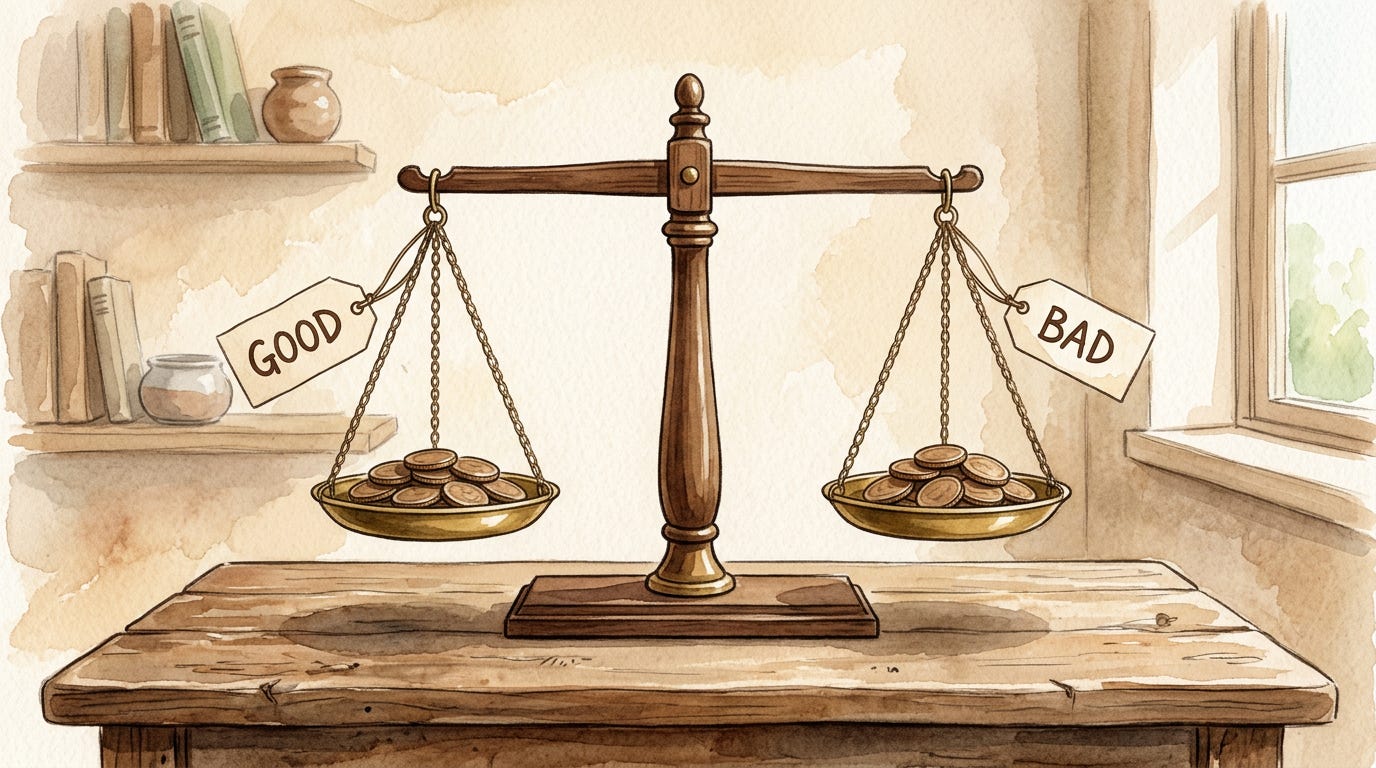
The moral framework we’ve built around debt makes some people feel justified, and others feel judged. But some traditional financial advice won’t tell you that the categories are mostly fiction. Debt is a financial tool, and tools aren’t moral. The way you think about your debt might actually feel heavier than the amount you owe.
In What Debt Really Feels Like, we talked about how debt feels in your body and brain. In The Debt We Don't Talk About, we explored the secrecy and isolation that shame creates. This post is about the moral weight we pile on top of all that, and what happens when you set it down.
The Morality We Put on Money
Somewhere along the way, we started attaching virtue and vice to financial instruments. “Good” debt builds something: a house, an education, a business. “Bad” debt funds consumption: clothes, vacations, survival. The categories sound reasonable until you push on them.
The student who took on “good debt” for a degree that never delivered the promised salary, are they virtuous? The person who put groceries on a credit card because there was no other option, are they irresponsible?
Pew Research found that 62% of people feel that being in debt is a personal failure. That tells you something important: the moral framework isn’t really about the debt. It’s about judging people. But life doesn’t sort that neatly. Debt happens for reasons, and those reasons are almost always more complicated than a label can hold.
When “Good” Isn’t Good and “Bad” Isn’t Bad
Student loans are supposed to be the gold standard of responsible borrowing, but the average balance sits around $38,000, and millions of borrowers are trapped in decades of payments for degrees that never delivered the promised returns. Mortgages are the “smartest” debt you can carry, right up until the market crashes and “investment” becomes “foreclosure.”
Now flip it around. The credit card that covered rent during a layoff? The personal loan that helped someone leave a dangerous living situation? All of it gets labeled “bad” because it didn’t build an asset on paper. But it built a bridge to the other side of a crisis, and that counts for more than any spreadsheet can capture.
“Good” and “bad” depend on the outcome, not on the type of loan. And outcomes depend on factors way beyond any one person’s control. Over half of credit card debt in the U.S. goes toward essential expenses, not discretionary spending. When the categories ignore that context, they’re not helpful. They’re just another source of shame.
The Condemnation That Isn’t Coming From Where You Think
The harsh moral judgment we apply to debt often sounds religious, but it doesn’t actually reflect what Scripture says about human worth.
The Apostle Paul wrote, “There is therefore now no condemnation for those who are in Christ Jesus” (Romans 8:1, ESV). Read that one more time. No condemnation. Not “no condemnation once you’ve paid off your credit cards.” Not “no condemnation for people who only carry ‘good debt.’” No condemnation, period.
The voice that whispers “you’re a bad person because you have debt” isn’t the voice of God. It’s the voice of a culture that has quietly confused financial success with moral worth. And that confusion runs deep enough that it can feel like truth even when it’s not.
Jesus actually warned against exactly this kind of judgment: “Judge not, that you be not judged” (Matthew 7:1, ESV). The moral framework that sorts debt into “good” and “bad” might sound righteous, but when it’s mostly just adding shame to people who are already struggling, it doesn’t sound like good news at all.
What If Debt Just... Is?
Try this reframe: debt is simply a record of resources you accessed before you could pay for them. It isn’t a moral ledger or a character assessment; it is simply a financial fact.
Some of your debt helped you build, some helped you survive, and some came from choices you might make differently today. In the end, it’s all just debt, or simply numbers on a statement.
This doesn’t mean debt doesn’t matter, because it absolutely does. Interest rates are real. Payment obligations are real. The stress is real. But the moral weight? That part is optional. You added it, or culture added it for you, and you can set it down.
When you let go of moral judgment, you can see the debt more clearly. You can ask straightforward questions like “what’s the interest rate?” and “what’s actually sustainable for me?” without every question feeling like a verdict on your worth as a person.
Rewriting Your Debt Story
Your debt has a story. What is it?
Pay attention to the language you use when you think about it. Do you call it a “burden”? A “mistake”? “Irresponsible”? Those are moral frames, and they carry weight all on their own. Try swapping them for neutral ones: “My debt came from this situation.” “The circumstances at the time were these.” “I made this choice because of what I was facing.”
If a close friend told you their debt story, you’d probably say, “That makes sense, you were dealing with a lot.” Can you offer yourself the same thing? Reframing doesn’t change the numbers, but it changes what the numbers mean. And meaning affects everything: your stress, your willingness to engage, your belief that things can get better.
One Thing This Week
Write out your debt story in neutral terms. No moral adjectives, not “stupid,” not “irresponsible,” not even “bad.” Just the facts. “This debt came from X. The circumstances were Y. At the time, I was dealing with Z.” Then read it back to yourself. Notice how different this version feels from the story shame usually tells. The facts are exactly the same. The judgment is gone. What changes for you when you read it that way?
Next in the series: We’ll talk about the harder, longer question. How do you actually live with debt without letting it drown out everything else?
This content is for educational purposes only and should not be construed as financial or therapeutic advice. Consider speaking with qualified professionals for personalized guidance.