

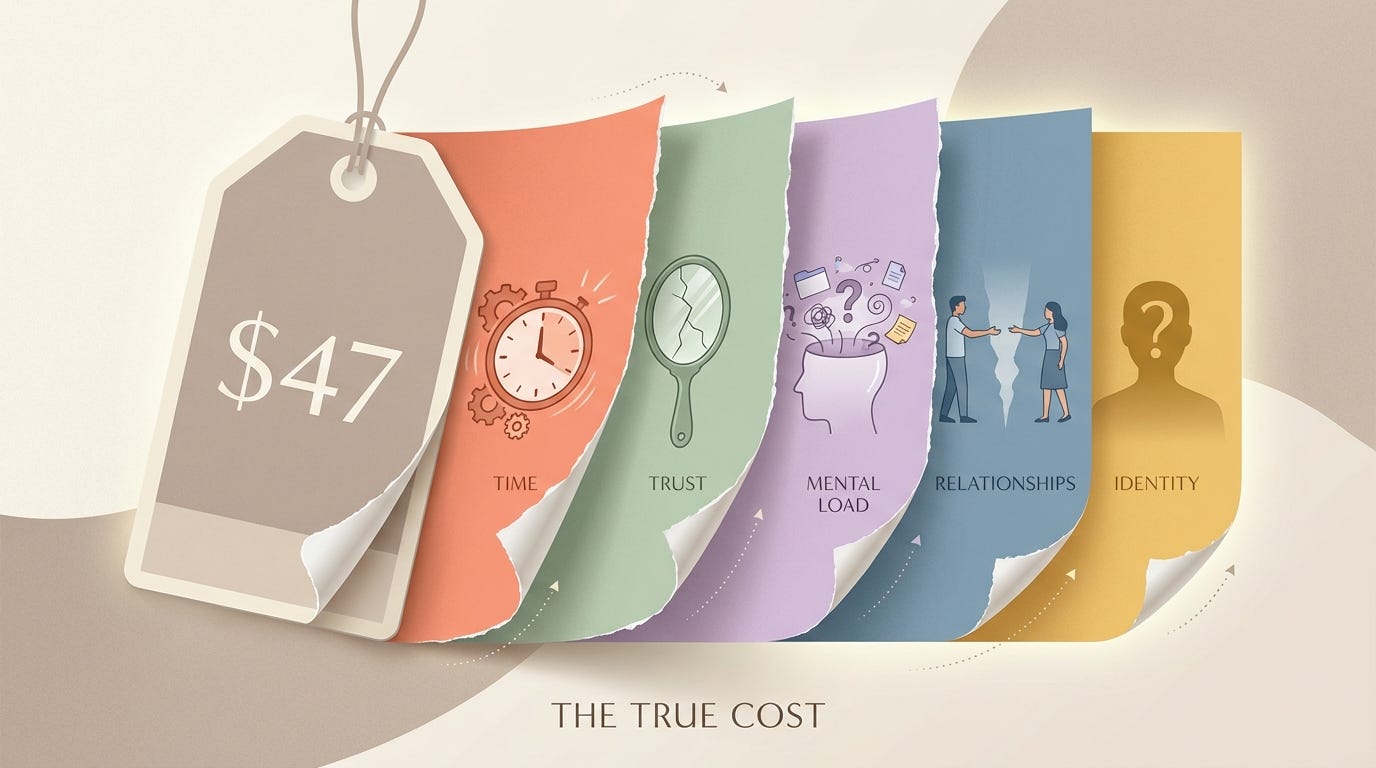
The $47 impulse buy isn’t really about $47.
It’s about the hour you spent browsing when you could have been doing something that actually fills you up. It’s about the slight erosion of trust in yourself every time you promise “this is the last time” and then do it again. It’s about the mental space that purchase now occupies—the packaging to deal with, the decision about whether to keep it, the guilt that shows up every time you see it.
We’ve spent the last few posts understanding why boredom shopping happens. The uncomfortable nature of boredom itself. The dopamine-seeking system that drives the urge. The specific triggers that make you vulnerable.
Now let’s talk about what this pattern actually costs. Because once you see the full price tag, the math starts to change.
The Time Tax
Before you ever click “buy,” you’ve already paid.
Research on digital consumer behavior shows that the average person spends 6 hours per week browsing online shopping sites. Not shopping. Browsing. That’s 312 hours per year. Thirteen full days.
Add in the time comparing prices and reading reviews. Adding items to the cart and removing them, tracking packages, handling returns, and managing the items once they arrive.
One study from Princeton found that for every dollar spent on impulse purchases, consumers spend an average of 23 minutes across the entire shopping cycle. That $30 shirt? You invested nearly 12 hours between discovery and decision.
The opportunity cost is staggering. What could you have created, learned, experienced, or connected with in those hours? What did you actually want to do with that time before your brain offered shopping as the easy escape from boredom?
Time is the one currency you can’t earn back. When you spend it browsing to avoid discomfort, you’re not just losing money, you’re trading your actual life for the illusion of novelty.
The Trust Erosion
Every time you promise yourself you won’t shop bored again and then do it anyway, something shifts.
Not dramatically, or all at once. But a small crack forms in your relationship with yourself. You told yourself something, and you didn’t follow through. Your brain takes note.
This is what psychologists call “reduced self-efficacy.” Your confidence in your ability to do what you say you’ll do gradually diminishes. And that reduction doesn’t stay contained to shopping. It bleeds into other areas.
If you can’t trust yourself with a shopping app when you’re bored, can you trust yourself with that career change you’re considering? That difficult conversation you need to have? That creative project you keep putting off?
The research is clear. Studies on self-control show that repeated failures in one domain create what’s called “learned helplessness” in others. You start to see yourself as someone who “just can’t help it” or “has no willpower.”
But here’s what’s really happening. You’re not weak. You’re trying to use willpower to fight brain chemistry and app design engineered to exploit your vulnerability. The game is rigged, but you’re blaming yourself for losing.
Still, the damage to self-trust is real. And it compounds. The less you trust yourself, the more you seek external comfort. The more you seek external comfort, the more you shop. The more you shop, the less you trust yourself.
Breaking this cycle isn’t about willpower. It’s about understanding what’s actually happening and choosing to opt out of the rigged game entirely.
The Mental Load
Walk into your closet or open that junk drawer. How much of what you see came from boredom shopping?
That pile of stuff isn’t neutral. It’s not just taking up physical space; it’s taking up mental space.
Research from UCLA’s Center on Everyday Lives found that clutter is directly correlated with cortisol levels. The more stuff people have, the more stressed they feel—even when they’re not consciously thinking about the stuff.
Every item you own is a tiny decision waiting to be made. Wear it or donate it? Keep it or sell it? Fix it or throw it away? Use it or store it? Your brain tracks all of this in the background, creating what’s called “decision fatigue.”
Neuroscientist Daniel Levitin found that the average person makes 35,000 decisions per day. Every piece of clutter adds to that count. Your boredom purchases aren’t just items. They’re ongoing mental burdens.
And there’s an identity cost too. You bought that thing imagining a version of yourself who would use it, wear it, become it. When you don’t become that person, the gap between who you are and who you thought you’d be sits in your closet, quietly judging you.
That’s not the stuff’s fault. It’s the inevitable result of shopping to solve an emotional problem. The purchase can never deliver what you were actually seeking because what you were seeking wasn’t a thing at all.
The Relationship Ripples
Money fights are one of the leading predictors of divorce. And boredom spending often lives in secrecy.
Not always. Sometimes it’s out in the open. But even then, there’s usually a gap between what you tell yourself about your spending and what’s really happening. That gap creates distance from partners, family, or friends who might notice.
Studies in the Journal of Financial Therapy show that financial secrets, even relatively small ones, can lead to measurable increases in relationship stress. Not because of the money itself, but because of what hiding requires.
You have to remember what you said. Track what arrived when. Explain away packages or new items. The mental energy this takes is energy you can’t invest in actual connection.
And if you’re partnered with someone working toward shared financial goals, boredom spending pulls in the opposite direction. Not maliciously or intentionally, but it pulls nonetheless.
The cost isn’t always obvious. Sometimes it’s just the slow build-up of small missed connections, like when you chose shopping over being there, avoided chats due to guilt, or stopped sharing dreams because they felt too far out of reach.
Reframing the Real Cost
Here’s a different way to calculate what boredom shopping actually costs:
Time Cost: Hours spent browsing, buying, managing, returning × what you could have done with that time instead.
Trust Cost: How does this pattern affect your confidence in yourself? Your belief that you can do hard things?
Mental Cost: What is the cognitive burden of managing all this stuff? How much decision fatigue does it create?
Relationship Cost: What distance does this create? What conversations does it prevent? What dreams does it delay?
Identity Cost: Who did you think you’d become through this purchase? What does the gap between that person and reality do to your sense of self?
The financial cost is real. But these other costs often matter more. They’re just harder to see until you start looking.
What Changes When You See the Full Price
Understanding these hidden costs doesn’t make boredom shopping stop immediately. Remember that you’re up against neuroscience and app design. Knowledge alone won’t override the dopamine hit.
But something does shift. The next time you feel the pull to browse when bored, you might pause and ask: “What am I actually about to pay here?”
Not just the dollars, the hour, the small crack in self-trust, or the mental clutter. It’s the distance from what I actually want for my life.
Sometimes you’ll still choose to shop. And that’s okay. But you’ll be choosing with full information rather than just reacting to discomfort.
Over the past five posts, we’ve built a complete picture. You understand why boredom feels so unbearable. You know how your brain’s seeking system works. You’ve mapped your personal triggers. You can see the full cost.
Now there’s just one question left: What do you actually want instead?
This content is for educational purposes only and should not be construed as financial or therapeutic advice. Consider speaking with qualified professionals for personalized guidance.