

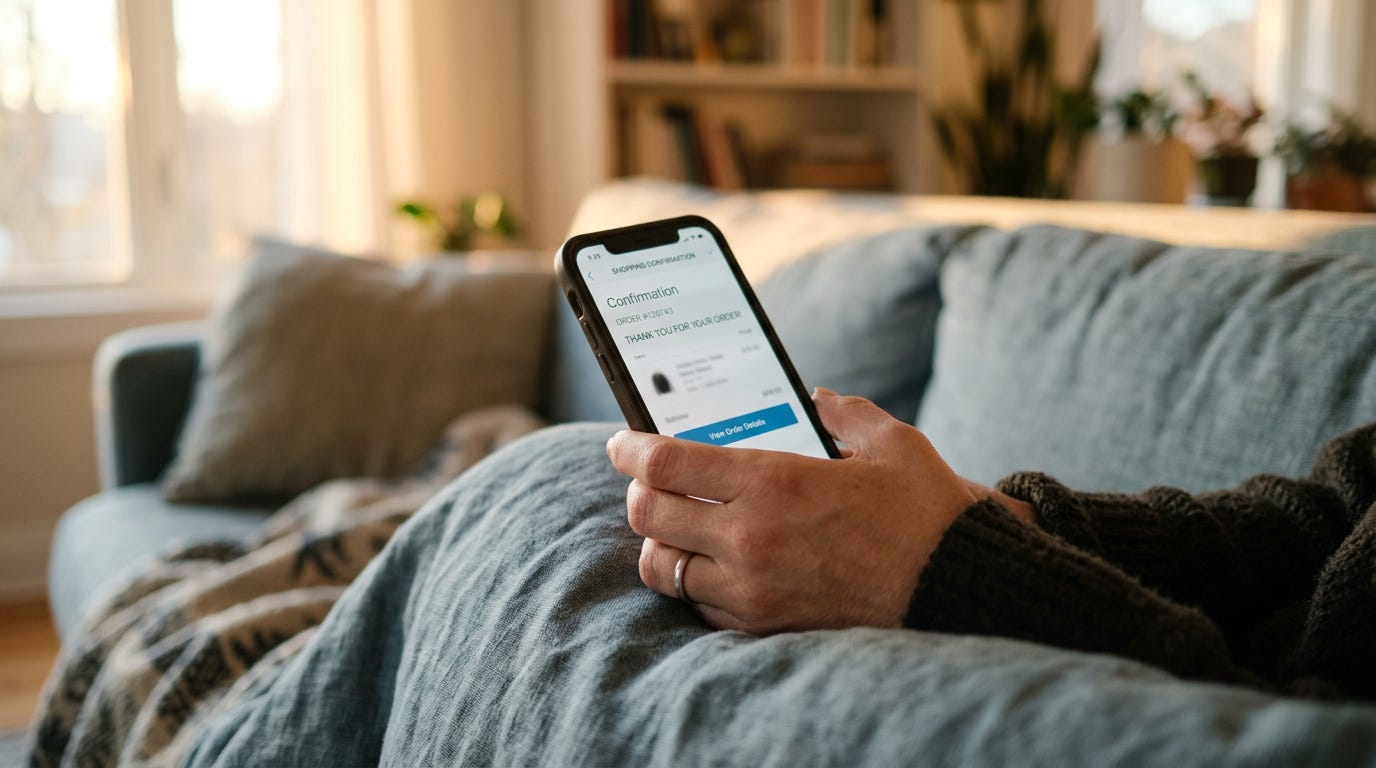
Stressful afternoon. Inbox full, something went sideways at work, and somewhere between 4 and 7 PM, you bought something you didn’t plan to buy. Maybe it’s small, a candle, a shirt, a meal you didn’t really need to order. For a little while, something loosens. Then later, when you’re checking out or lying in bed or looking at your account the next morning, a different feeling shows up.
If that sequence sounds familiar, there’s a reason it keeps happening. And it has nothing to do with self-control.
What’s actually happening in your brain
Yesterday, we talked about how financial stress activates the same threat response your brain uses in response to physical danger. When you’re in that state, your brain is flooded with cortisol and actively looking for a way out. Spending gives it one.
Neuroimaging research by Knutson and colleagues in 2007 found that the anticipation of a purchase lights up the nucleus accumbens, the brain’s reward center, while activity in the prefrontal cortex, the part that weighs consequences and thinks about the future, actually decreases. The “yes, I want this” feeling doesn’t arrive after careful consideration. It arrives before the “wait, should I?” question can form. That ordering is biological, not a failure of discipline.
The relief that follows is real. Dopamine-mediated purchase relief lasts roughly 20 minutes before the brain’s reward signal normalizes. For those 20 minutes, the cortisol that’s been running in the background has something to compete with. The stress doesn’t disappear, but it steps back a little. That’s not nothing. The brain files it under “this worked.”
The problem is what comes next.
The numbers are harder to ignore than we’d like
A 2020 study in the Journal of Consumer Psychology found that financially anxious people averaged 34% more impulse purchases than people with lower financial anxiety. Their unplanned spending per purchase was about 27% higher than their planned spending per purchase. The researchers also found something worth sitting with: the size of the purchase didn’t matter much to the relief signal. A $6 coffee and a $60 jacket produced the same short-term dopamine response. The brain isn’t purchasing the item; it’s purchasing the feeling.
This is worth naming plainly. The spending is doing a real psychological job, and in the short term, it’s doing it reasonably well. The issue isn’t that the relief doesn’t come. The issue is the financial and emotional costs of the relief, and how short the window actually is.
The layer that makes it worse
About 20 minutes after an unplanned purchase, once dopamine levels normalize, guilt tends to set in. And guilt compounds the original anxiety rather than relieving it. Now you have the original stressor, plus the awareness that you spent money you hadn’t planned to spend, plus potentially a lower account balance than you had before, which, as we covered yesterday, is its own trigger for the financial threat response.
This is the loop. Anxiety leads to spending, spending brings brief relief, relief fades into guilt, guilt feeds the anxiety, and the anxiety goes looking for relief again. Around and around.
Naming it a loop matters. A loop is a system. Systems can be understood and interrupted. The alternative framing, that you’re just bad with money or have no willpower, doesn’t offer any of that. It just adds shame to the stack, and shame is one more thing the brain will eventually try to spend its way out of.
The loop isn’t a character description. It’s a pattern. Patterns have entry points.
One thing to try in the next 24 hours
You don’t need to stop anything yet. What’s useful right now is just noticing. In the next day or two, if you feel the pull toward an unplanned purchase, see if you can pause long enough to ask: what was happening in the hour before this? Was there a stressor? A moment of frustration or uncertainty or low-grade dread?
You don’t have to do anything differently. Just notice the gap between the trigger and the purchase impulse. That gap is small, but it exists, and it’s where everything we’ll talk about later in this series becomes possible.
Tomorrow we’re going to map your specific version of this loop, because the triggers, the relief purchases, even the guilt, they tend to look different from person to person. Understanding your particular pattern is more useful than knowing the pattern exists in general.
This content is for educational purposes only and should not be construed as financial or therapeutic advice. Consider speaking with qualified professionals for personalized guidance.