

If you experienced childhood poverty or financial trauma, some of these memories may be difficult to revisit. Go gently with yourself. You don't have to read this all at once, and having someone you trust nearby is never a bad idea.
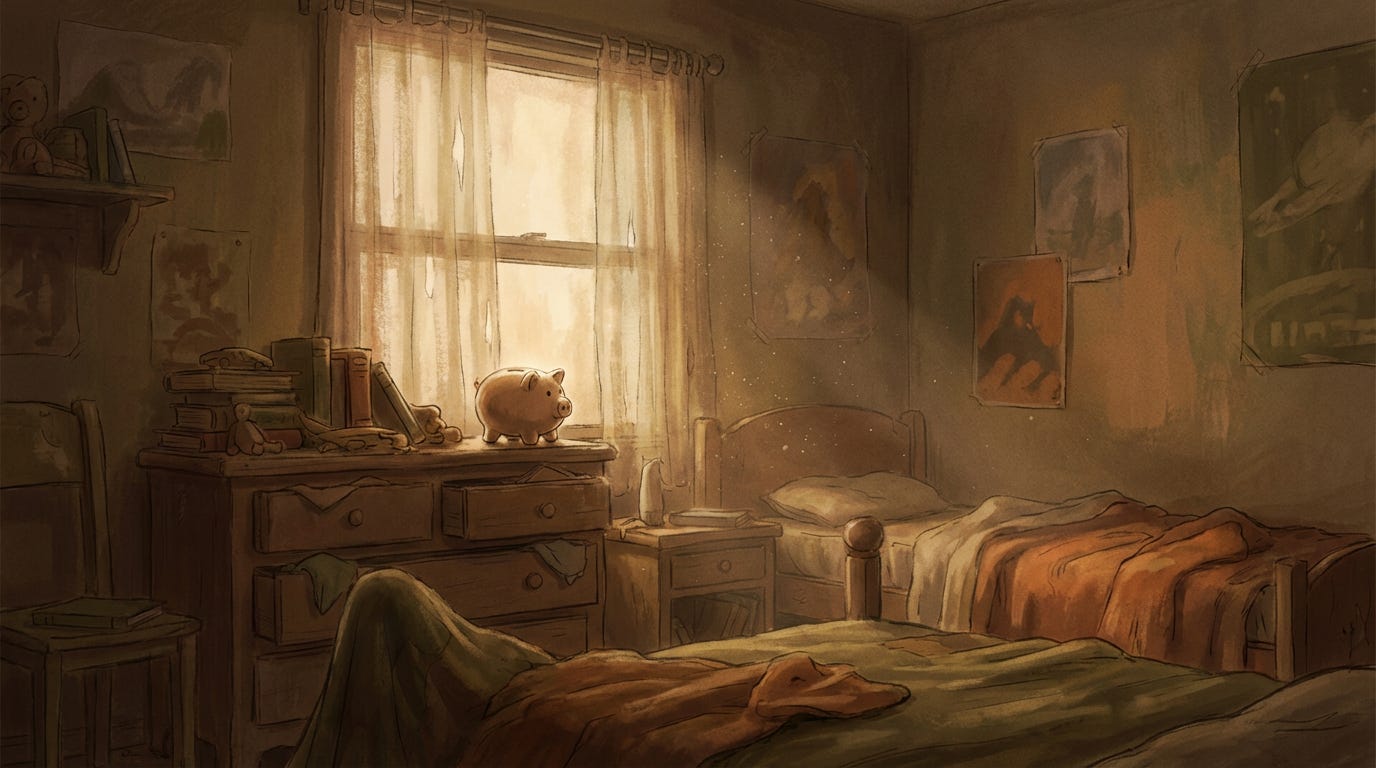
You have money in the bank. The bills are paid. There’s food in the fridge. And yet something in you is still scanning for the threat, still bracing for the bottom to drop out, still whispering “it’s not enough, it’s never enough.”
That voice is from a true, learned place. The real question is whether it still applies, and whether it’s even possible for it to learn something new.
Your Brain Learned What It Needed to Learn
Scarcity thinking isn’t a character flaw or a failure to “be positive.” It’s an adaptation, plain and simple. If you grew up wondering whether there would be enough food, whether the electricity would get shut off, whether you’d have to pack up and move again, your brain encoded a survival lesson: resources are unreliable, so always prepare for less.
That wasn’t pessimism. It was intelligence. A child who assumes there’s plenty when scarcity is the daily reality gets caught off guard. A child who assumes scarcity when scarcity is real survives. Your brain did exactly what it was designed to do. It protected you with hypervigilance, with a need to hold on tight, with a quiet baseline assumption that good things don’t last.
The problem isn’t that you learned this. The problem is that the learning stays with you long after the circumstances that created it are gone. Your brain wrote that lesson in permanent marker, and now you’re trying to revise it with a regular pen. Even so, gentle and gradual change is possible. Over time, with patience and compassion for yourself, those old lessons can begin to soften and shift. Your efforts really can make a difference.
The Many Faces of Formative Scarcity
Scarcity thinking doesn’t have just one origin story; there are many paths that lead to the same place.
Childhood poverty is the most obvious one. You learned early that money was precarious, that adults worried about bills, that “we can’t afford it” was the answer to almost everything.
Sudden loss is another. You didn’t grow up without, but something collapsed, and it collapsed fast. A parent lost a job. A medical crisis ate through savings. A divorce restructured everything. The lesson your brain took away: stability is an illusion.
Generational transmission is subtler but just as real. Your grandparents survived the Depression, or war, or immigration, and they passed a kind of ambient fear down through the family. You carry scarcity that you didn’t personally experience, but it lives in you like a hand-me-down that fits too well.
Financial abuse is another path. When someone used money as a way to control you, scarcity wasn’t just about resources. It was about power and safety. Those two things get tangled up together.
Chronic instability looks different from all of these because there was technically “enough,” but it never felt secure. The unpredictability itself, the feast-or-famine rhythm, was enough to train your nervous system to stay on guard.
All of these experiences create the same neural imprint: the world is not safe, resources are unreliable, and you need to stay ready for the worst. Research suggests that around 35% of adults report some form of financial trauma, and studies going back decades show that children who experience poverty carry altered stress response patterns well into adulthood, even when their financial circumstances improve significantly.
What This Actually Feels Like
Scarcity thinking isn’t just a thought pattern you can catch yourself in. It lives in your body.
It’s the inability to enjoy what you have because part of you is already mourning losing it. It’s guilt when you spend on anything that feels “unnecessary.” It’s hoarding behaviors that feel almost compulsive, whether that’s money, food, or random objects you might someday need. It’s physical anxiety around purchases you can actually afford. It’s the constant mental calculation, always running the numbers, always watching the meter. It’s feeling like a fraud when things are going well, waiting for the other shoe to drop. And sometimes it’s a quiet resentment toward people who seem financially carefree, people who just buy a thing without a second thought.
If any of this resonates, you’re not broken. You’re adapted. Your nervous system is running software that was designed for a different environment. The question is whether that software can be updated, and the encouraging answer is yes, but it takes time, and it takes patience. There are small, manageable ways to begin shifting this, and change can start with gentle steps. You don’t have to overhaul everything at once.
A Different Kind of Provision
(The following resonates regardless of your faith and religion)
There’s an old story about a group of people learning to trust provision in a place that had none. The Israelites, freshly freed from slavery, wandered into a wilderness with no food and no obvious plan. God sent manna, bread that appeared on the ground each morning, but with unusual instructions: gather only what you need for today. Those who hoarded found it rotted by morning (Exodus 16).
The lesson wasn’t “scarcity isn’t real.” They were literally in a desert. The lesson was to trust the Provider, not just the provision. Daily dependence, not accumulated security.
The psalmist puts it this way: “The LORD is my shepherd; I shall not want” (Psalm 23:1, ESV). Not “I shall have everything I desire,” but “I shall not want,” meaning I will have enough. Sufficiency, not luxury. Provision, not wealth.
That doesn’t erase material hardship or make the anxiety vanish. But it points toward something underneath the circumstances: a faithfulness that isn’t contingent on the balance in your account.
Where to Start This Week
Don’t try to feel abundant. That’s too far a leap from where you are.
Instead, this week, just trace the origins. Where did your scarcity thinking learn what it learned? What experiences taught your nervous system that resources are unreliable? You don’t have to fix anything or reframe anything. Just sit with it long enough to say, “Of course I feel this way. Look at what I went through.”
If reflecting feels overwhelming or too intense at any point, give yourself permission to pause. This work can bring up strong emotions, and it is okay to take breaks whenever you need them. If it feels helpful, reach out to someone you trust or a professional for support. Remember that being gentle with yourself is part of the process.
Compassion for your own history is the first step toward freedom from it.
Next up, we’ll dig into what scarcity actually does to your brain, and why willpower alone can’t override it.
This content is for educational purposes only and should not be construed as financial or therapeutic advice. Consider speaking with qualified professionals for personalized guidance.