

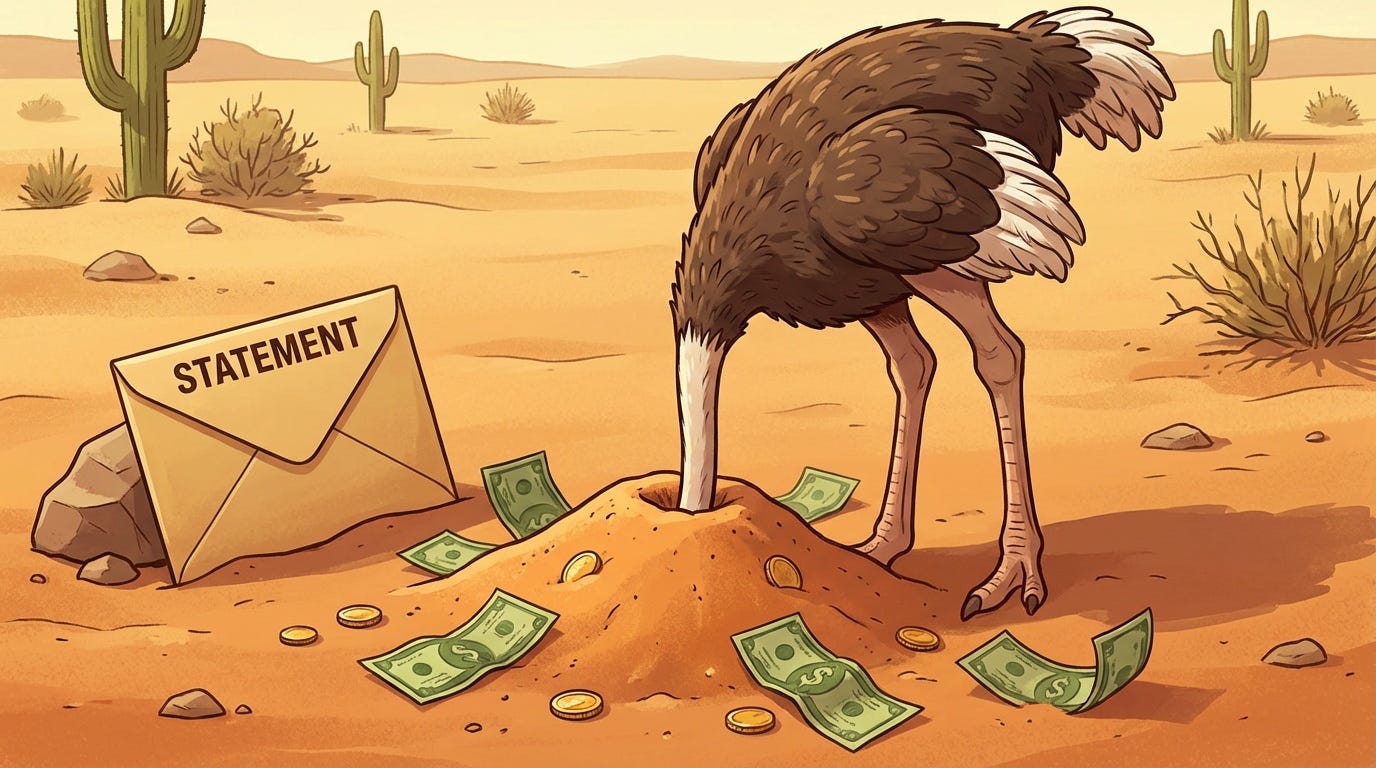
You know the credit card bill came three days ago. You know the student loans haven’t disappeared. You know there’s a number in your bank account, and part of you suspects it’s not a great one.
And still, you don’t look.
You can tell yourself tomorrow, or you can open the app and close it before the screen loads. You may have gotten really good at deleting notifications without quite reading them.
This isn’t laziness or irresponsibility either. Your brain is doing exactly what it was built to do.
The Ostrich Effect
Researchers call this the ostrich effect. A 2009 study found something strange: when the stock market drops, people check their investments less. Not more, like you’d expect. Less.
When the news might be bad, we’d rather not know. We bury our heads.
The pattern shows up everywhere—retirement accounts, medical test results, and difficult conversations. When information might hurt, we turn away.
Your Brain on Financial Threat
There’s a small part of your brain called the amygdala. It’s been keeping humans alive for thousands of years. Its job is simple: spot danger, sound the alarm.
When your ancestor saw a tiger in the grass? The amygdala flooded their body with adrenaline before they even consciously registered the threat.
Here’s the problem. Your amygdala can’t tell the difference between a tiger and a bank statement.
Research shows that the amygdala drives a phenomenon called loss aversion. Losing $100 feels twice as bad as the good feeling of finding $100. That math helped our ancestors survive—losing your food supply is more dangerous than finding extra food.
But in modern life? It means your brain treats money problems like physical threats.
Think about checking your debt balance. Your heart speeds up. Your stomach tightens. Your thinking brain starts going offline. And your brain offers a simple solution: don’t look.
In that moment, not looking feels like safety. To your threat-detection system, it is safety. The tiger you don’t see can’t hurt you.
Why “Face the Music” Doesn’t Work
Ever been told to “face the music” or “rip off the bandaid”? You’ve probably noticed that advice is useless.
There’s a reason.
Psychologist Kurt Lewin described something called approach-avoidance conflict. You want to know your finances (approach). You also want to avoid the pain of bad numbers (avoidance). These pull in opposite directions.
The key insight: the avoidance force gets stronger as you get closer. The fear grows faster than the motivation.
This explains why you can decide at 10 AM to check your credit card tonight—and by 8 PM, you absolutely cannot make yourself do it. From a distance, looking feels manageable. Up close, the alarm bells drown everything out.
The Cost of Not-Knowing
Here’s what your protective brain misses: the tiger is still there whether you look or not.
The bills don’t pause. The interest keeps growing. The late fees don’t wait for you to feel ready.
But something else happens, too. Something more challenging to see.
Part of you always knows you’re avoiding. That creates a low-level hum of anxiety that colors everything. A flash of guilt when you buy coffee. Tension when a friend mentions money. A vague dread you can’t quite name but can’t shake either.
The paradox of avoidance: not-knowing often feels worse than knowing. The imagined disaster is usually bigger than the real numbers.
But getting to the relief of knowing means walking through fear first. And your brain is specifically designed to stop that walk.
What Now?
I’m not going to tell you to check your accounts. We’ve established that doesn’t work.
Instead, here’s something smaller.
This week, notice when you avoid.
Just let it be. Avoid straining yourself to look. Focus on those instances when you turn away. Pay attention to what prompts that action. Take note of how it manifests in your body—the sense of relief, the underlying tension, and the swift negotiations with yourself.
Notice without judging yourself for it.
You’re not avoiding because you’re weak or bad with money. You’re avoiding because your brain is trying to protect you from what it sees as danger. That protection made sense once. Understanding it is the first step toward something different.
Next up: the different flavors of financial hiding. Avoiding your bank account is only one way we turn away from money. You might be surprised by patterns you didn’t know you had.
This content is for educational purposes only and should not be construed as financial or therapeutic advice. Consider speaking with qualified professionals for personalized guidance.